
1. Introduction: The Statutory Foundation of Income Taxation
The Income-Tax Act, 1961, is not a static collection of rules but a sophisticated legislative engine designed for the precise calibration of fiscal liability. At its core lies Section 4 (Charge of Income-tax), the operational mandate that empowers the state to levy tax for any assessment year. This section functions as the Act’s primary gear, decreeing that tax shall be charged at rates prescribed by the annual Finance Act in respect of the "total income" of the previous year for every person. By deferring specific rate-setting to the Finance Act, the legislature ensures the Act remains a flexible instrument of economic policy.
The jurisdictional reach of this charge is governed by Section 5 (Scope of Total Income), which strategically delineates liability based on residency. For residents, the Act asserts a global claim, capturing income derived from any source whatsoever. Conversely, non-residents are cordoned off, with liability restricted to income that is received, accrued, or arises within India. This foundational architecture creates a clear hierarchy of fiscal exposure, where the individual’s status determines the volume of wealth subjected to the Act’s progressive mechanisms.
2. Defining the "Maximum Marginal Rate" and High-Income Liability
A critical instrument in the Act’s progressive design is the "Maximum Marginal Rate" (MMR), codified under Section 2(29C). This definition serves as the legislative bridge between the permanent Act and the fluctuating Finance Act. The MMR represents the statutory ceiling of the tax hierarchy, defined as the rate of income-tax—expressly including any applicable surcharge—applicable to the highest slab of income for individuals, associations of persons (AOP), or bodies of individuals (BOI).
From a strategic perspective, Section 2(29C) allows the Finance Act to "set the dial" on the maximum burden for the most affluent earners. By identifying the highest income group and subjecting them to this peak percentage by design, the Act ensures that the tax burden is not merely proportional but increasingly intensive. The inclusion of the surcharge within the MMR definition further emphasizes that high-income liability is intended to be the ultimate threshold of fiscal contribution. This statutory peak ensures that as an assessee’s income transcends into the highest bracket, their effective tax percentage is locked at the maximum legislative limit, transitioning the focus from broad income slabs to the specific "Heads of Income" that determine the taxable base.
3. Categorization of Income: The Five Heads of Liability
The legislature utilizes Section 14 to compartmentalize liability, ensuring that the percentage of tax paid is a function of the income's source as much as its volume. By dividing income into five distinct "Heads," the Act effectively cordons off different economic activities to apply specific rules of computation and relief.
The five heads of income are:
Salaries (Section 15)
Income from house property (Section 22)
Profits and gains of business or profession (Section 28)
Capital gains (Section 45)
Income from other sources (Section 56)
Strategically, these heads provide the first layer of relief through fixed deductions, such as the standard deductions under Section 16 for Salaries and the statutory deductions for repairs under Section 24 for House Property. However, these provisions are architected to be of diminishing value to the wealthy; as gross income grows, these fixed deductions become mathematically negligible, causing the effective tax percentage to rise. Furthermore, the Act aggressively captures specific high-value gains through the Section 115 series. For instance, Section 115BB targets winnings from lotteries or horse races with a high flat percentage regardless of the individual’s general income group. Even more potent is Section 115BBE, which imposes a rigorous tax percentage on "unexplained" wealth referred to in Sections 68, 69, 69A, 69B, 69C, and 69D (such as unexplained investments or money). This ensures that unexplained or high-risk gains are subjected to aggressive capture, reinforcing the progressive burden.
4. Residency Status: A Multiplier of Tax Exposure
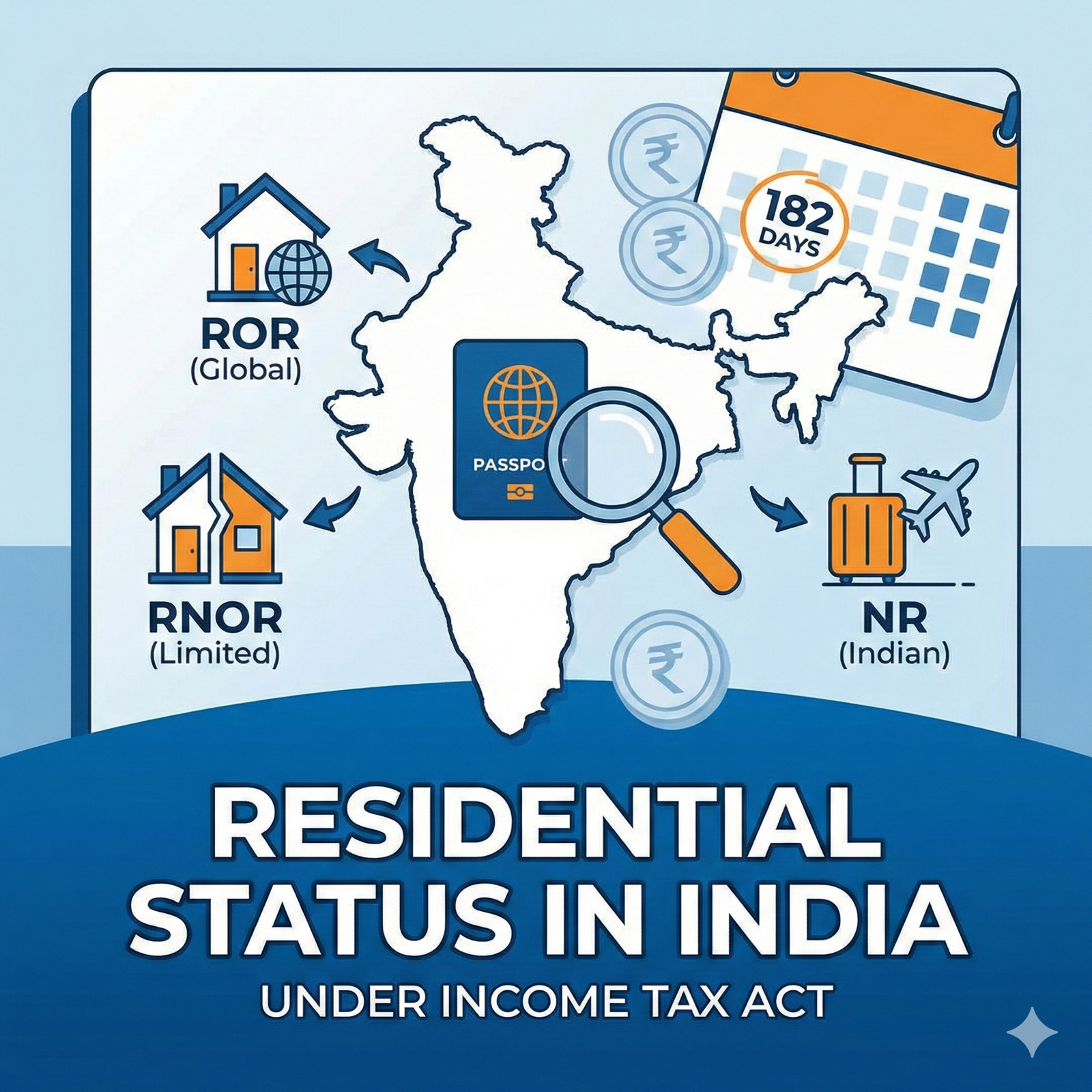
Even if a source of income is identified, the volume of that source captured by the Act is entirely dependent on the individual's residency status under Section 6 (Residence in India). Residency acts as a multiplier of fiscal exposure. While a non-resident’s liability is limited to Indian-sourced income, a resident’s entire global economic footprint is brought into the Indian tax net.
The Act employs specific thresholds to trigger this full liability:
Section 6(1)(a): Presence in India for 182 days or more in the previous year.
Section 6(1)(c): Presence for 60 days in the current year combined with 365 days over the preceding four years.
Section 6(6): Defines "Resident but Not Ordinarily Resident" (RNOR), providing a transitional mitigation for those who have been non-residents in nine out of ten preceding years.
A major strategic nuance is found in Section 6(5), which establishes an "all-or-nothing" rule: if a person is resident for one source of income in a previous year, they are deemed resident for all sources of income for that year. This provision prevents high-income individuals from splintering their residency status across different income types, ensuring the Act captures the maximum possible volume of global wealth.
5. Mitigating the Tax Burden: Rebates and Deductions
To balance the Act’s inherent progressivity, Chapter VI-A (Deductions) and Section 87A (Rebates) provide relief, yet these provisions are strategically "regressive" in their eligibility. The Act maintains a sharp distinction between a Deduction (which reduces the total taxable income) and a Rebate (which directly reduces the tax payable).
While Chapter VI-A deductions (under Sections 80C through 80U) allow for the reduction of the taxable base, they are often capped at specific limits that high-income earners quickly exhaust. More significantly, Section 87A functions as a "binary cliff." This rebate is designed to reduce the tax payable for individuals in lower-income groups to zero. However, once an assessee’s income crosses the statutory threshold, the eligibility for the rebate vanishes entirely. This creates a sharp spike in the effective tax percentage for those moving out of the lower-income group, as the full weight of the tax slabs is suddenly felt without the mitigating buffer of the rebate. Consequently, high-income earners are denied these primary relief mechanisms, ensuring they bear the maximum fiscal burden.
6. Final Analysis: The Progressive Burden
The Income-Tax Act, 1961, represents a deliberate architecture of progressive liability. It ensures that the highest income group pays the highest percentage of tax through a compounding series of statutory hurdles: the application of the Maximum Marginal Rate (Section 2(29C)) which includes surcharges, the aggressive capture of unexplained or windfall wealth under Section 115BBE and 115BB, and the "all-or-nothing" residency multiplier of Section 6(5). By combining these with a "cliff-edge" withdrawal of Section 87A rebates and the outgrowing of fixed deductions under Sections 16 and 24, the Act focuses the nation’s fiscal weight squarely upon those with the highest economic capacity.
Expert Summary: The Income-Tax Act, 1961, ensures maximum fiscal contribution from the highest income groups through three strategic pillars: (1) Peak Percentage Capture via the Maximum Marginal Rate and the Section 115 series; (2) Total Volume Exposure through the Section 6(5) residency multiplier; and (3) Relief Exclusion through the regressive eligibility of Section 87A rebates and capped Chapter VI-A deductions. The result is a system where the effective tax rate accelerates as wealth increases, by statutory design.




















Write a comment ...