
In India, income tax liability is not determined by citizenship but by residential status. An individual’s residential status must be determined afresh for every Financial Year (FY). The status for the FY 2025-26 will determine the taxability of income for the Assessment Year (AY) 2026-27.
Broadly, an individual falls into one of three categories:
Resident and Ordinarily Resident (ROR)
Resident but Not Ordinarily Resident (RNOR)
Non-Resident (NR)
Step 1: Determining if You Are a "Resident"
Under Section 6(1) of the Income Tax Act, an individual is considered a Resident in India in any previous year if they satisfy any one of the following basic conditions:
Condition A (The 182-Day Rule): You are in India for a period of 182 days or more during the financial year.
Condition B (The 60 + 365 Rule): You are in India for 60 days or more during the financial year AND have been in India for 365 days or more within the 4 years immediately preceding that financial year.
If you do not meet either of these conditions, you are a Non-Resident (NR).
Exceptions to Condition B (The 60-Day Rule)
There are specific cases where the "60 days" in Condition B is replaced by 182 days. In these cases, you only become a resident if you stay in India for 182 days or more:
Employment Abroad: An Indian citizen who leaves India during the year for the purpose of employment outside India.
Crew Members: An Indian citizen who leaves India as a member of the crew of an Indian ship.
Visiting India (Standard): An Indian citizen or a Person of Indian Origin (PIO) who is settled abroad and comes on a visit to India.
Important Amendment for High-Income Visitors: If an Indian Citizen or PIO visits India and their total income from Indian sources exceeds ₹15 Lakhs during the year, the "182 days" requirement is reduced to 120 days.
Implication: If they stay for 120 days or more (but less than 182 days) and have Indian income > ₹15 Lakhs, they become a Resident. However, they are specifically classified as RNOR (Resident but Not Ordinarily Resident).
Step 2: "Deemed Resident" (Section 6(1A))
Introduced by the Finance Act 2020, this provision targets high-net-worth individuals who arrange their affairs to avoid paying tax in any country.
An individual is considered a Deemed Resident if they meet all three criteria:
They are a Citizen of India.
Their total income from Indian sources exceeds ₹15 Lakhs during the financial year.
They are not liable to tax in any other country or territory by reason of domicile, residence, or similar criteria.
Note: A "Deemed Resident" is always classified as RNOR.
Step 3: Classifying Residents (ROR vs. RNOR)
If an individual qualifies as a "Resident" (Step 1 or Step 2), the next step is to determine if they are "Ordinarily Resident" (ROR) or "Not Ordinarily Resident" (RNOR).
Who is Resident but Not Ordinarily Resident (RNOR)?
An individual is RNOR if they satisfy any one of the following:
The 9/10 Rule: They have been a Non-Resident in India in 9 out of the 10 financial years preceding the current year.
The 729 Days Rule: They have been in India for 729 days or less during the 7 financial years preceding the current year.
The High-Income Visitor Rule: They are an Indian Citizen/PIO visiting India who stayed for 120 to 181 days and has Indian income exceeding ₹15 Lakhs.
The Deemed Resident Rule: They are a "Deemed Resident" under Section 6(1A).
Who is Resident and Ordinarily Resident (ROR)?
An individual is ROR if they do not fall into the RNOR category. Typically, this means they satisfy both of the additional conditions:
Resident in India in at least 2 out of 10 previous financial years.
Stay in India for 730 days or more in the 7 previous financial years.
Taxability Based on Residential Status
The scope of taxable income differs significantly between these categories (Section 5):
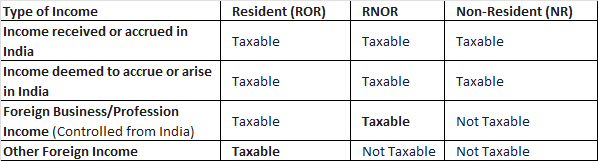
Key Takeaway:
ROR: Pays tax on global income (worldwide income is taxable in India).
RNOR: Pays tax on Indian income + Foreign income derived from a business controlled in India. Other foreign income is exempt.
NR: Pays tax only on income earned, accrued, or received in India.
Summary Checklist for FY 2025-26
Stay < 60 days? -> Non-Resident (NR).
Stay more than or equal 182 days? -> Resident. (Check ROR/RNOR conditions).
Stay 60–181 days?
Generally NR, unless you meet the "365 days in 4 years" test.
If you are an Indian Citizen/PIO visiting India:
Income < ₹15L: NR.
Income > ₹15L: RNOR (if stay is more than or equal 120 days).
Indian Citizen living in a tax-free country (e.g., UAE)?
If Indian income > ₹15L and not taxed elsewhere -> Deemed Resident (RNOR).





















Write a comment ...